Archives For pau gasol

One of the key developments from Tuesday’s win over the Bobcats was that Mike D’Antoni went all-in with his move of MWP to power forward. What at first looked to be a temporary move to off-set Pau Gasol’s absence from the lineup has now (seemingly) become permanent strategy.

If we flashback to June of this year, playing Ron at power forward was something I thought should happen. Here’s (some of) what I said at the time:

Once upon a time, Ron was one of the best two way players in the league and while his decreased athleticism has made him less effective, he’s still got all the facets of his game. He has a good handle, can create off the dribble for himself or teammates, is a decent shooter from the outside, and can post up and finish in the paint. Defensively, we know that Ron can still play well even though his foot speed isn’t quite what it was when he first came to the Lakers. But, overall, these are skills that could translate well to playing some PF if the Lakers decide they want to go small…

…Simply by having Ron space the floor against traditional PF’s the Lakers could open up their offense more. His ability to knock down open shots or drive past slower closeouts could also boost his effectiveness as a play maker. He still shows good instincts when moving into open space, bodying up his man, and in chasing loose balls, which would aid him when rebounding on both sides of the ball. Defensively he has the foot speed to keep up with most PF’s and has the strength to battle anyone in the post. In the past two seasons the Lakers have switched Ron onto Blake Griffin and Kevin Love on key possessions late in games to get the stops they sought. He held his own against both players and they happen to be two of the better players at that position.

As the league moves forward there will be a greater emphasis on lineup versatility. We’re seeing it right now in the Finals with LeBron and Durant both staples of traditional and small lineups their teams deploy. And while Ron isn’t in those players class as elite talents, his skill set is varied enough and his tenacity more than enough that a part time role as a PF could be worth exploring more in the future.

Well, the future is here. Ron is the Lakers’ back up PF and with tectonic plates of this lineup shift comes a myriad of aftershocks that will be felt across the landscape of the Lakers’ roster.

Below are some of my initial thoughts on what this move means:

*The Lakers’ roster is now woefully unbalanced. Ron’s move means that he joins Pau, Dwight, Jamison, Hill, Earl Clark and Sacre as players who could be classified as either power forwards or centers in D’Antoni’s system. Ron’s move away from the wing means that the only “small forward” on the roster is Devin Ebanks and the only shooting guards are Kobe and Jodie Meeks. At point guard, the Lakers have Nash, Steve Blake, Darius Morris, and Chris Duhon. When looking at that list of players, the wing positions are extremely shallow while the PG, PF, and C positions are overloaded. There simply aren’t enough minutes for the all the Lakers’ big men to play and once Nash and Blake are healthy, there won’t be enough minute at point guard either. At this point, the only way to re-balance the roster is to either make a trade or to shift players (like Ron or Jamison) back to small forward in order to lessen the burden on the wings. Because if that doesn’t happen…

*Kobe and Meeks are about to play a ton of minutes. This has already been true so, in one respect, this wouldn’t be a change from recent trends. However, with Ebanks’ utility as a contributor limited, coach D’Antoni has already hinted that Jodie Meeks will start at SG with Kobe sliding up to Ron’s old position. This creates an entirely new set of questions that will need to be answered over time.

First, who plays back up SG if Meeks starts? Ebanks is not a SG (this has been proven pretty well over the past two seasons) so he doesn’t seem like a good candidate. Darius Morris has okay size, but he’s not ideal either. Darius Johnson-Odom is a natural shooting guard, but he’s also a rookie and seems better suited to a D-League assignment in order to get experience, not playing key minutes for the big team. How this gets sorted out will be key because playing Kobe and Meeks together for long stretches (something that Nash coming back doesn’t really change) means the wing depth will be severely tested in a way that, as of now, would seemingly produce poor results.

Who guards the elite small forwards if Ron is on the bench to start games? Ever since Ron has joined the team he’s taken the more difficult defensive wing assignment whether he’s been a shooting guard or a small forward. But if Meeks starts instead of Ron, Kobe will no longer have the option of playing the lesser wing. Instead, defensive assignments will be dictated more by position. Does that mean Kobe has to guard Durant? Carmelo? LeBron? What about non-superstar, but still quality SF’s like Nic Batum, Kirilenko, Rudy Gay, Gerald Wallace, or Caron Butler. Will he have to guard the better offensive option regardless of position (James Harden when the Rockets visit, for example)? Playing bigger players each night while still carrying a heavy offensive load and playing heavy minutes is a concern here.

*Does Ron playing PF make Pau the new Bynum? Under Phil Jackson, the Lakers often played Odom with one either Gasol or Bynum to form the foundation of their most effective lineups. To close games, Gasol would slide up to center and Odom would play in Bynum’s place. This lineup created versatility on both ends of the floor and was the key front court tandem that helped win back to back titles. As mentioned in the cited post from June, Ron offers many of the same qualities that Odom did as a PF in terms of offensive and defensive versatility. Against the Bobcats, Ron closed the game playing defense against a perimeter oriented big man and spacing the floor offensively. This left Pau on the bench while Dwight manned the pivot.

In the future, will we see more of this? Will Pau only occasionally close games? Can the Lakers afford to have one of their best 4 players on the bench down the stretch of close games? The answers to these questions aren’t yet known but Pau has already expressed his desire to be in the game late when the score is tight. Furthermore, the Lakers’ potential ceiling was always built around the idea that all four of the Lakers big players would be able to thrive on the floor together. Getting the most out of them is important not only when lineups are staggered, but when they all play together. How D’Antoni manages this will be very important as the season progresses.

*What happens to Jamison and Hill? After the Bobcats game D’Antoni said “to no fault of their own” both players would be out of the rotation for now. From a practical standpoint, this makes some sense. Jamison is a reserve PF who is best as a floor spacer. Jordan Hill, though a good PF in Mike Brown’s system, is a C in D’Antoni’s spread attack. Ron has taken Jamison’s spot and with Pau back, he’s the natural fit as a five-man when Dwight is on the bench. With only 96 minutes of game time to split between PF and C, a three man rotation is easiest to deploy and that leaves Hill and Jamison out in the cold.

That said, both players bring useful qualities to a shallow Lakers’ roster. Hill’s rebounding and ability to hedge/recover are valuable to a team that sees countless P&R’s ran at them every game. Jamison’s ability to score points in bunches have already helped the Lakers win more than one game this season. They’re also two of the Lakers best 10 players and removing them from the rotation entirely weakens a team that doesn’t have a lot of useful depth. There’s no easy answer here. I think both players will be needed over the course of the rest of the season. Will they be ready when called upon? Is there a risk of losing them to disinterest and dissatisfaction? Both have proven to be professionals and hard workers for the Lakers. I’d think that remains true regardless of circumstances. That said, it must be disappointing to be demoted in the manner that they have been.

Ultimately, I like having Ron play more PF. I think it helps the Lakers in a variety of ways by diversifying what they can do on both sides of the ball. The fact that Ron is having a resurgent season makes it so the Lakers are playing to some of their strengths in ways that they weren’t earlier in the year. That said, it’s clear this change exposes other stress points on the team that weren’t necessarily there before. Getting Nash back will help in some ways, but not all of them. And we’ll know more about this team over the course of the next month when everyone is healthy enough to play.

Hopefully, in that stretch, we get some answers to these lingering questions.

Records: Lakers 8-9 (9th in the West), Rockets 8-8 (7th in the West)
Offensive ratings: Lakers 105.1 (5th in the NBA), Rockets 104.1 (t-7th in the NBA)
Defensive ratings: Lakers 99.4 (8th in the NBA), Rockets 103.4 (21st in the NBA)
Projected Starting Lineups: Lakers: Chris Duhon, Kobe Bryant, Metta World Peace, Antawn Jamison, Dwight Howard
Rockets: Jeremy Lin, James Harden, Chandler Parsons, Patrick Patterson, Omer Asik
Injuries: Lakers: Pau Gasol (out), Steve Nash (out), Steve Blake (out); Rockets: Cole Aldrich (questionable)

In fairness to these Lakers, the 2012-13 season has presented a stream of tumult maddening not only in its persistence but also its diversity.

Spend the summer building a quad-HoF juggernaut around an (exhaustingly discussed) offense that risks marginalizing your new all-universe playmaker, watch it do so for precisely one full game before losing said playmaker to a broken leg (and his primary backup to an abdominal injury), while the squad actually thrives offensively but can’t keep the opponent off the scoreboard (or the win column) to the extent that your defensive guru coach is shown the door. Dogmatically pursue the coach with whom you dominated the previous decade before employing one of the great play-fakes in modern HR history and opting for the himself hobbled professional soul mate of your banged up point guard, and win four of five to return to break-even while awaiting his arrival.

The summer’s top get, the generational big man expected to author a new chapter in the franchise’s already glorious tome, months after undergoing major (I don’t believe there’s any other kind) back surgery, has, in mere weeks, allayed any lingering concerns about his ability to regain his characteristic dominance. The bench has (as it is wont to do) frustrated, though recent flashes of competence (no longer, mind you, from last spring’s surprise find, the backup center who’s now been buried on an NBA bench twice by the same coach) are certainly fodder for optimism.

The team’s since found firm-enough footing to rank in the league’s top third in efficiency at both ends of the floor, with Kobe Bean not only continuing to dominate on a nightly basis, but doing so in as efficient and mature a manner as we’ve ever seen.

And yet, the Lakers continue to drop more games than they win.

Now? Big boy pants.

Seriously, it’s never nothing with this crew.

To paraphrase ex-NFL coach/exec Bill Parcells, at some point, you simply are what your record says you are. Set aside payroll, prestige, raw talent and past achievement. 8-9 is 8-9. Yes, there have been injuries and upheaval, and yes, continuity cannot be achieved overnight, but – if I may once again channel my inner Tuna – don’t tell about the labor pains, show me the baby. The Lakers have certainly encountered some bumps in the road, and there can be little doubt that this team’s best is yet to come. It’s worth noting, however, that no team featuring peak-Kobe and well-on-his-way Dwight Howard – two players whose mere presence all but ensures 50 wins and the playoffs – never mind one that’s played 12 of the its first 17 games at home (not counting a “road” game against the Clippers), ought to be struggling (and, at present, failing) to keep its head above water more than 20% of the way through a season.

This is certainly not meant to suggest that the Lakers will be spectators come playoff time, but to continue to shoehorn this team – this turnover-plagued atrocity at the free throw line, yet again (for now) lacking at the point – into the ranks of the NBA’s contender is to invite more disappointment into a season that’s been defined by just that.

Tonight, in the absence of Pau Gasol (knee tendinitis), the Lakers travel to Houston, to square off against the team to which they last December actually traded their embattled scapegoat extraordinaire.

I have never shared the unflattering view of Gasol that – almost from the moment he was acquired, and in spite of his vital role in three conference titles and two banners – permeates Laker Nation. The unshakable “soft” label that has adhered itself to him (even after 19 and 18 in Game 7 of the NBA Finals against the team that had tormented him two years earlier) is nothing short of absurd. That he, one of the most gifted big men in NBA history, has maintained his grace and professionalism despite constantly demeaned as such by his own fans (never mind violently threatened on a regular basis by a disgusting but high-decibel minority), incessantly involved in trade speculation and actually traded a year ago is as impressive as anything he’s managed on the floor.

That said, at this moment, Pau is frankly not a good NBA player. That he’s struggling to define a niche for himself in a new system is well documented, as is the discomfort in his knees that will keep out of action tonight. What’s bothersome, however (as we discussed on the Silver Screen and Roll podcast, recorded prior to Sunday night’s game), is the extremity of his passiveness and failure to execute certain basic, system-neutral basketball plays (like wide open 18-foot jump shots and basic pick-and-roll defense) that have twice led to his watching the final moments of a Laker defeat from the bench.

That said, however, in this, the first of seven road contests in their next eight outings, Gasol’s absence will be absolutely glaring. Much of the attention focused on these Rockets tends to be directed at the high-profile backcourt of Jeremy Lin (11.6 points on 51% FG, 4.2 rebounds, 6.4 assists and 2 steals per game in his last five) and noted Laker antagonist James Harden (24, 6.8 assists, 2.4 steals and 46.4% from 3-point range during the same span), but the front court is where the Rockets have done the bulk of their damage en route victories in four of their last five. The onus tonight will fall squarely on the shoulders of Metta World Peace and Antawn Jamison, as their counterparts, Chandler Parsons (21.5 points, 7 rebounds and 57.9% from 3 in Houston’s last four wins) and Patrick Patterson (20 and 6 over his last five, 20+ points four times and 54% from the field) will command their full attention, as offseason steal Omer Asik (15.5 and 14 in his last five, and 25-of-38 from the field) will likely keep Howard occupied and unable to offer as much help as the Lakers might prefer.

Tuesday night’s outing in Houston offers up comprehensive challenge for the Lakers: win a road game (they’ve lost four of five this season), even more short-handed (say what you will about Pau…), despite starting one of the NBA’s most defensively challenged forwards against a hot-handed frontcourt. Because these Lakers are these Lakers, it wouldn’t be at all shocking to see them return to .500 tonight. To do so, however, it will take a massive effort from the front line (both defensively and on the boards), Kobe doin’ more work and, in all likelihood, a trip out of Mike D’Antoni’s doghouse for Jordan Hill.

Rockets Blogs: Check out The Dream Shake and Red94 for some excellent coverage of these Rockets.

Where you can watch: 5:00pm start on TWC Sportsnet. Also listen at ESPN Radio 710AM.

Records: Lakers 6-5 (6th in the West), Kings 2-8 (15th in the West)
Offensive ratings*: Lakers 105.9 (5th in the NBA), Kings 94.5 (27th in the NBA)
Defensive ratings*: Lakers 98.4 (8th in the NBA), Kings 102.1 (18th in the NBA)
Probable Starting Lineups: Lakers: Darius Morris, Kobe Bryant, Metta World Peace, Pau Gasol, Dwight Howard
Kings: Aaron Brooks, Tyreke Evans, John Salmons, Jason Thompson, DeMarcus Cousins
Injuries: Lakers: Steve Nash, Steve Blake; Kings: none

The Lakers Coming In: …over .500, baby! WOOOOO!!!!!

Whaddya want? For a ragtag group of upstarts, it’s all about baby steps.

In all seriousness, the Lakers arrive will celebrate Thanksgiving not in the state we’d expected prior to the season, but as close to it as we’ve seen thus far. After scuffling (mild understatement) to a 1-4 start (and the end of the Mike Brown regime), the Lakers have crept into the NBA’s top third at the defensive end, while their offense – never the issue to begin to begin with – continues to rank among the league’s best. Winners of five of six since Mike Brown’s dismissal and six of eight overall, the Lakers have (for the moment) overhauled the narrative that perpetually surrounds this team, moving the pessimism and nitpicking of a week ago to the back burner, in favor of the optimism that accompanies the gradual cohesion of a new cast

Last night marked the young season’s high water mark, as the artists formerly (and probably again in the future) known as Team Turmoil not only gutted out a solid victory over a talented Brooklyn Nets squad in Mike D’Antoni debut on the bench, but did so with a strong defensive effort, holding four of five Nets starters under 40% from the field, while Dwight Howard turned in his best performance as a Laker (23 points, on 8-of-11 shooting, 15 rebounds and four blocks) and Kobe Bryant – despite a late game dalliance with “hero ball” that so perturbs some observers – continued to exhibit efficiency seldom seen from the Mamba, pouring in 25 on just 15 shots, and adding four boards and five dimes.

Unfortunately, in order to pull out the win, the Lakers were forced (as they often will be against quality opposition) to run four of their five starters (all except Darius Morris) at least 39 minutes. Not exactly an ideal start to a four-games-in-five-days stretch (that includes roadies in Memphis and Dallas) for a veteran squad whose top two point guards are on the shelf.

Enter the Sacramento Kings…

The Kings Coming In: According to the standings, the Kings have managed a pair of victories in 10 outings to start the 2012-13 season. Their statistical profile, however, suggests otherwise. Seriously, this team is downright AWFUL.

Only three teams are managing fewer points per 100 possessions than the Kings’ 94.5. Only the Pacers and Wizards boast a lower eFG% than Sacto’s 44.9%. The Kings are connecting at a below-average rate from all area of the floor (in fairness, they are average from 10-15’), have the third-worst Assist Rate in the league and have had one in every 11 shots blocked. (You hear that, Dwight?)

Defensively, there’s not much to write home about either. Though they rank in the league’s middle third in points allowed per 100 possessions, only two teams (Charlotte and Detroit) are allowing offensive rebounds OR free throws at a great clip, and only the Cavs and the Knicks are allowing a higher field goal percentage at the rim than Sacramento’s 68.7%. (Hi Dwight!)

On the bright side, DeMarcus Cousins is back from the absurd suspension that kept him out of the Kings November 11 loss to the Lakers. Incredibly gifted as he is, however, Cousins’ tendency to get caught flat-footed defensively (and the resulting propensity for foul trouble) will likely limit his impact against whichever of the Lakers’ bigs he’s matched up against.

Kings blogs: For the view from the other side, check out the fantastic work turned in by Sactown Royalty and Cowbell Kingdom.

Keys to the Game: Expect Dwight Howard and Pau Gasol to own the offensive glass – and, consequently, to own DMC and Jason Thompson as well – with Kobe continuing to play some of the most efficient ball we’ve seen in years, against a perimeter defense that is simply incapable of preventing him from having his way.

I’ve done this before, with checkered results is memory serves, but if the Lakers are mentally present at Sleep Train Arena (this name makes me so sad), a comfortable victory – and perhaps a quarter of rest for the first stringers – ought to be in the cards.

Where you can watch: 7:00pm start on TWC Sports Net. Also listen at ESPN Radio 710AM.

The version of the Princeton offense the Lakers will use this season has the chance to be an evolving oasis of offensive possibility. The sheer talent and versatility of their core four players can translate to a multitude of actions — some obvious, some not so much — that can hurt a defense in a variety of ways.

When the Princeton was first talked about as a system the Lakers would employ, one of the first things that came to mind was Pau Gasol operating at the high post. Using Pau at that spot on the floor, with Howard occupying the low block, would take advantage of his elite passing while also utilizing his ability to space the floor as one of the better mid-range shooting big men.

This, of course, has become a staple of what the Lakers do run on offense. Every game we’ve been treated to at least one Gasol dime to Howard where he makes a catch at the elbow and plays high-low basketball with his frontcourt partner. As the season advances and these two develop even more chemistry, we should see even more of this action and little wrinkles added to it to force defenses into making the types of lose/lose choices that often result in made baskets.

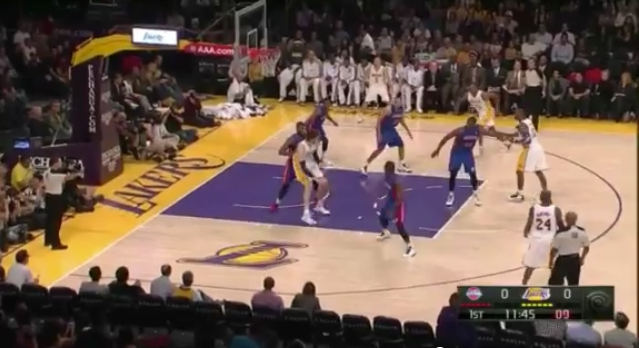
However, one of the not so obvious ways the Lakers have started to take advantage of their talent has been the inverting of their big men. Against the Pistons, the Lakers ran several actions that put Pau at the low block and left Howard at the high post. This is the opening play of the game:

This play starts as many Lakers’ sets have lately, with the point guard (Steve Blake in this instance) bringing the ball up the left side of the floor with Kobe on the wing and Dwight in the ball side post. Blake enters to Kobe who looks to Dwight for a quick post up. Instead of entering the ball, Kobe passes the ball back to Blake who then enters a quick pass into Dwight as he slides up the lane line to the elbow. Blake then screens away for Pau who pops open at the top of the key where he gets the ball from Howard. This is where the heart of this action comes to life.

After Pau gets the ball at the top of the key he swings the ball back to Kobe and then rubs off a high pick from Dwight to dive to the low post. Kobe hits Pau with an entry pass while Howard hovers around the free throw line. It’s important here to note how closely Howard’s man is playing him and how much room Pau has to work on the post:

Pau post up

With all this room, Pau backs his man down and shoots a half hook that misses. But since he’s maneuvered his way around his man, he follows his shot, gets the offensive rebound and scores easily on a put back. It bears repeating, in this next still Howard isn’t even in the picture and Maxiell still hasn’t left the FT line area to help on the glass and is watching as Pau scores an easy two points:

Pau put back

One of the key reasons this set works is that the Lakers have put Pau in the post and spaced the floor in a way where if the double team comes Gasol can use his tremendous passing ability to hit the open man.

Furthermore, with Dwight at the elbow, the defense has a unique problem. If Dwight’s man leaves to double team he’s allowing Howard to dive from the FT line with the best passing big man in the league ready to drop him off a pass that will surely end with either a basket, a foul, or both. Not to mention that if Dwight’s man leaves him but the pass doesn’t go to him, he still has a wide open lane to crash the glass and be an offensive rebounder.

What the Lakers have figured out — and based off how many times they ran a variation of this set, they have figured something out — is that the defense must respect Dwight if he’s anywhere near the paint. His ability to cut to the ball and score off passes or simply get to the front of the rim for rebounding chances means that his man has to keep within arm’s distance of him at nearly all times or risk being exposed.

This doesn’t have to be a full time set for the Lakers. Dwight is still best served operating from the low post and trying to score on his man via touches in the paint. Many of those touches will come from the splendid passing ability of Pau. But there will be times where the Lakers can invert their bigs and use Pau’s strength as a post scorer to their advantage and not hesitate. Even though Dwight doesn’t have range on his jumper and isn’t known as a great high-low passer, it doesn’t matter. He’s too dangerous to leave.

Offensive spacing can come from many places. In this case it comes from Dwight Howard standing at the foul line. Not sure many people saw that coming.

The Pau of Los Angeles

Danny Chau —  October 29, 2012

I’d like to welcome Danny Chau as a contributor to FB&G. He’ll be joining us from time to time to write on the Lakers, basketball in general and, if we’re lucky, what he ate for lunch and where he got it. Danny brings a unique and incredibly thoughtful writing voice to the game we love and his L.A. roots make him well versed on what the Lakers mean to the city and the league at large. We’re lucky to have him. You can find more of Danny’s work at Hardwood Paroxysm and you can follow him on twitter here. His first effort is on Pau Gasol. Enjoy.

A nationally broadcasted Lakers game wouldn’t be complete without the panned-out shot of the ubiquitous Hollywood sign, standing tall and inert as it has been for almost 90 years. Hollywood is the spiritual home of the Los Angeles Lakers, a team with a history of blockbusters and A-list celebrities — and that doesn’t count the stars who attend home games. The team is one of the most recognizable in all of sports, and the idea of Hollywood is one of America’s most important and enduring cultural exports. It’s a symbiotic relationship that begets continued dominance.

With the introduction of Dwight Howard and Steve Nash, the Lakers have their highest-profile team in almost a decade. The team, if the Hollywood spirit is still alive and well, will be among championship favorites just from the breadth of their star power. And in one fell swoop, Pau Gasol, once the team’s unquestioned second option, becomes the fourth player mentioned in any Lakers conversation. Naturally, he takes it in stride. After all, after a couple years of dealing with serious trade rumors and internal strife, it’s probably a blessing just to be standing as a Laker.

But Gasol’s relationship with dominance—and with those who expect him to dominate—has been tenuous at best, nonexistent at worst. Three consecutive trips to the Finals (with each one incrementally better than the last) as Kobe Bryant’s right hand man can do wonders for a player’s image, but Gasol has found out how soon the heaps of praise can wither when expectations are stacked too high. In four years time, he shed the “soft” label and then, once again, emerged as one of the softest players in the league. This is no small feat given the timeframe.

However, it seems most can agree that Gasol’s role in on this season’s team will be a positive for all parties involved. But if Kobe, Dwight, and Steve keep the team Hollywood as Hell, where does that leave Pau? I suppose with the rest of Los Angeles — a county that doesn’t always have the luster of its internationally-recognized focal point, but one with a compelling collective narrative all its own.

Los Angeles is a sprawl — as iconic as New York but nowhere near as condensed.  It’s a result of centuries of various ethnic migrations and subsequent white flight. Good, bad, or neither, it’s how the county became the cultural jigsaw it is today. Each city is its own archive; many of which are part of a grander story of how the underrepresented can still cultivate vibrant communities in spite of external forces. It’s a collection of compartmentalized clusters loosely sutured together by the freeway system.

Navigating through the county is a lifelong endeavor, and there are many who have made it their life’s work to map out as much of L.A’s everchanging landscape as humanly possible. Of course, food is a convenient way to experience much of L.A.’s cultural diversity. But it’ll take a drive. In the day time, head to the Harvard Heights district for a pupusa; at night, have as many tacos as you can handle from the taco tables that line Pico Blvd. Less than five miles away is Langer’s, where you will get some of the best pastrami anywhere on earth. Neighboring cities Gardena and Torrance are about 20 miles south, home to many stellar mom-and-pop ramen shops. A few miles east is Bludso’s BBQ in Compton, where I would suggest the Texas Sampler (bring a friend, or five) and the mac and cheese.  And I’d be thoughtless to neglect the San Gabriel Valley, my home, which in my unbiased opinion has the best regional Chinese and Taiwanese fare in America.

(Oh, and one of the best burritos I’ve ever eaten was from a small little shack in La Puente, an almost exclusively Latino community. It’s a family business owned and operated by a Korean father and son, obviously.)

It’s all worth taking in. It just requires time and patience and gas.

Pau is reading The Taoof Pooh by Benjamin Hoff. Actually, he’s probably finished it by now. He’s not exactly taking up Daoist teachings from the source, but it’s a start. The core beliefs of Daoism center on the idea of flow and wu-wei, the way of being natural, of uncontrived action. Phil Jacksonsaid Gasol is the oil that makes the machine run. Kobe has said similar things in the past. Despite being lower on the chain of command, Gasol is the only player of the without a rigid set of objectives in the system. We have a good idea of what Dwight will bring to the team, and we know that Kobe, regardless of system, won’t be deviating far from what has made him the player he is. Nash’s historic shooting and pick and roll ability will both be viable at the beginning of any possession and as safety blankets when options begin to crumble. In an offense that won’t key in on strict sets and a defense with the most intimidating stopper in the league, Gasol will need to fluidly switch in and out of his many compartments to keep the Lakers steady. That means being a dual threat from the high post, defending the opposition’s best big man to give Howard the freedom to make plays elsewhere, and remaining aggressive on scoring opportunities.

A Gasol that can and does do everything on the court isn’t beyond the realm of possibility — he’s done it before. His game is understated; as understated as it can be when he’s basically good at everything. It’s easy to focus on Gasol’s startling passivity last year and how his role as a facilitator seemed to overshadow the rest of his game (never mind that Gasol averaged more shots a game than in any previous season as a Laker). With Andrew Bynum’s emergence over the last two seasons, Gasol adapted to the shift in focus in a sensible manner. Compartmentalizing his game allowed Bynum to blossom, but in sealing off portions of his game for the sake of continuity, he ceased to be the player the team needed. And when you’re playing alongside an obsessive maniac, dips in assertiveness are magnified. It’s baffling to consider Gasol the “glue guy” on this team when he is still among the league’s top talents, but he is. He’s the freeway system that can connect the team’s newfound diversity.

Pau is entering his fifth full season as a Laker, but there still seems to be a disconnect between the player he is and the player fans are expecting. In the new offense, perhaps Gasol’s freer role can serve as a reminder of why Gasol has been so integral to the Lakers’ success. With Howard and Nash soaking up a larger portion of the spotlight, it’s a good season to stop and appreciate the nuance of Gasol’s vision and footwork and balance. The team’s new look promises Michael Bay-esque explosions on screen. Gasol should ensure that the dialogue won’t be half bad either.

That Hollywood sign is why many come to Los Angeles, but you stay for the rest of it. Los Angeles is dense, but it rewards your effort. So take a drive. Maybe put on the new Kendrick Lamar album. The world of Los Angeles can’t be taken in all at once. There’s just too much there hidden from plain sight and so much left undiscovered. Absorb the experience in bits and pieces, and live without ever expecting to complete the jigsaw. If that sounds like an endeavor worth undertaking, then there’s one reason why Pau Gasol is worth rooting for.